People living in Dehradun sometimes forget that one of the best beginner treks in the entire Himalayas is practically in their backyard.
Nag Tibba — the Serpent’s Peak — stands at 3,022 metres in the Garhwal Himalayas of Uttarakhand. It is the highest peak in the lower Himalayan range. And honestly, if you have never done it, it should be the very next thing on your list.
This 2026 guide covers everything — the full itinerary, how much it costs, the best time to go, what to pack, and how to reach Pantwari from Dehradun. Whether you are a complete beginner or someone looking for a quick weekend escape, this is the only guide you need.
What Makes Nag Tibba Special?
There are hundreds of treks in Uttarakhand. So why is Nag Tibba consistently one of the most popular ones year after year?
A few simple reasons.
First, it is a weekend trek. You can leave Dehradun on a Friday evening or Saturday morning and be back by Sunday night. No need to take a week off from work or college.
Second, it is beginner-friendly. The trail is easy to moderate. There are no technical sections, no river crossings, no permit nightmares. Even someone who has never trekked before can complete this.
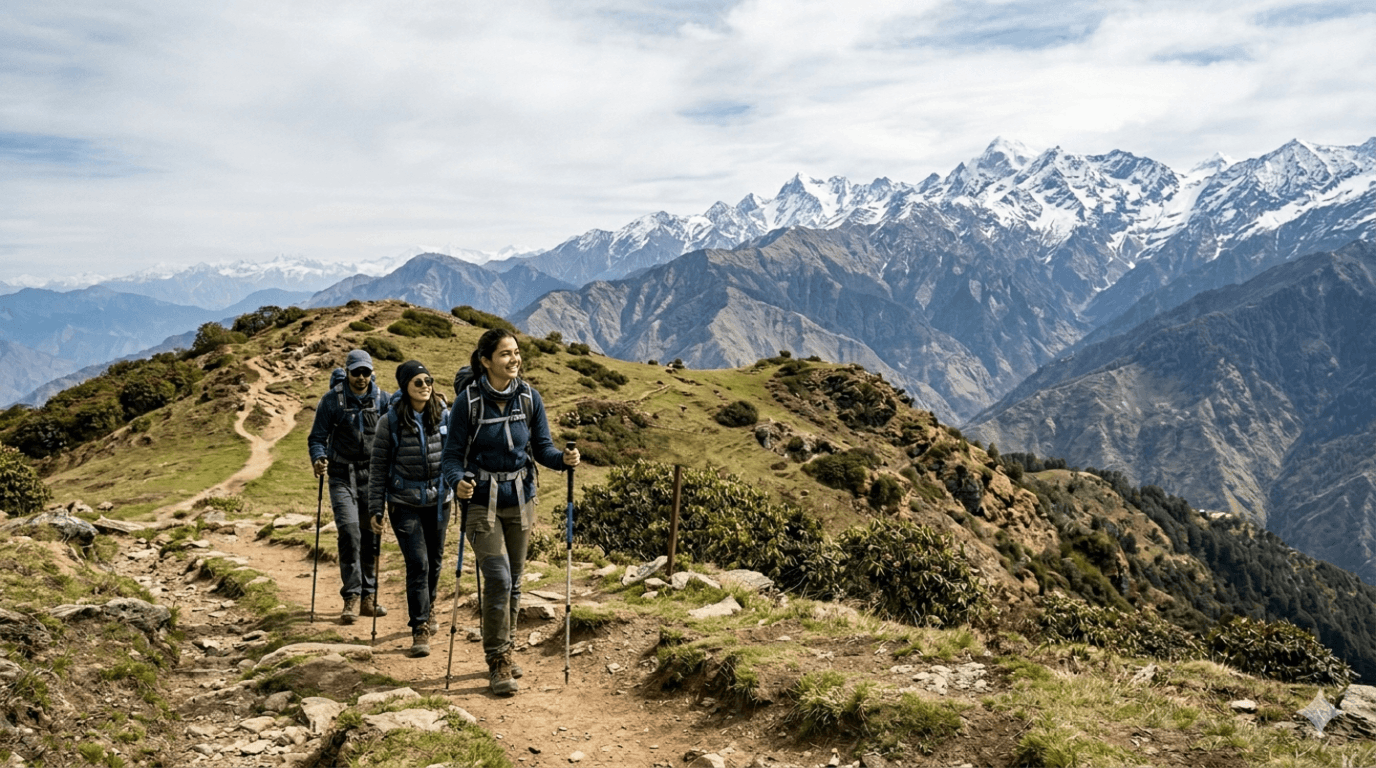
Third, the views from the summit are genuinely stunning. On a clear day, you can see Bandarpoonch, Swargarohini, Srikanth, the Gangotri peaks, Kedarnath, and Nanda Devi — all from one spot. That is the kind of panorama that usually takes a 7-day trek to find.
And then there is the campsite. The night sky at Nag Tibba base camp, with a bonfire and mountains all around — that feeling is very hard to describe until you experience it yourself.
Nag Tibba Trek — Quick Info at a Glance
| Detail | Info |
|---|---|
| Location | Pantwari village, Tehri District, Uttarakhand |
| Altitude | 3,022 metres (9,915 feet) |
| Trek Distance | ~16 km (round trip from Pantwari) |
| Duration | 2 days / 1 night (can be done in 1 day) |
| Difficulty | Easy to Moderate |
| Best Time | March–June & October–February |
| Base Camp | Pantwari Village (approx. 1,350 m) |
| Starting Point | Dehradun (90–100 km by road) |
| Minimum Age | 7 years and above |
| Package Cost | ₹2,599 to ₹8,000+ per person |
Nag Tibba Trek Route & Itinerary 2026
There are three routes to the Nag Tibba summit. The most popular and shortest one starts from Pantwari village, and that is what most organised trek packages follow.
Day 1 — Dehradun to Pantwari to Khatiyan Base Camp
Your day starts early. Most operators pick up trekkers from Dehradun Railway Station or a designated point by 6:30–8:00 AM.
The drive covers around 90–100 km, passing through Mussoorie and Kempty Falls, and then winding through the Nain Bagh area towards Pantwari. This takes about 4–5 hours by shared taxi or private jeep.
Once you reach Pantwari (altitude: ~1,350 m), you start the trek. The first part is on a cemented trail through the village and then into the forest. Dense oak, rhododendron, and deodar trees line the path. In spring, the rhododendrons are in full bloom — it looks like something out of a movie.
After about 4–5 km and 3–4 hours of trekking, you reach Khatiyan base camp at around 2,200 metres. This is where camp is set up for the night.
In the evening, you get your first real Himalayan experience — hot chai, dinner cooked at camp, a bonfire, and a night sky with zero light pollution. If you have never seen that many stars, prepare to be surprised.
Day 1 Trek Distance: ~4–5 km Camp: Khatiyan / Nag Tibba Base Camp
Day 2 — Summit Day & Return to Dehradun
This is the day everyone wakes up early for.
Start the summit push by 6:00–7:00 AM. The climb from base camp to the summit is around 4–5 km and takes about 3–4 hours. There are some steep sections near the top, but nothing that a reasonably fit person cannot handle with short breaks.
At the summit (3,022 m), you will find a small temple dedicated to Nag Devta — the Serpent God. According to local Garhwali belief, Nag Tibba is the home of the serpent deity and holds deep religious significance for people of this region.
From the summit, on a clear day, you get a 360-degree view of the Bandarpoonch range, Swargarohini, Srikanth, Jaonli, Kedarnath, and the Doon Valley below. It is one of those views you will remember for a long time.
After spending time at the top, you descend back to base camp for lunch, then continue down to Pantwari. The return drive to Dehradun takes another 4–5 hours. Most trekkers are back in Dehradun by 7–9 PM on Day 2.
Day 2 Trek Distance: ~9–10 km (summit + descent to Pantwari) Drop-off: Dehradun Railway Station / starting point
Three Routes to Nag Tibba
While the Pantwari route is the most common, here is a quick overview of all three options:
Route 1 — Via Pantwari Village (Most Popular) Distance: ~16 km round trip. This is the shortest and best-marked trail. Ideal for beginners. A guide is recommended but the trail is manageable.
Route 2 — Via Devalsari Village Distance: ~13 km one way. Longer approach but goes through beautiful deodar forest. Start from Devalsari and trek 3 more km to the top. Requires a permit from the Mussoorie Forest Office.
Route 3 — Via Aunter (Thatyur) The motor road via Thatyur takes you close to the ridge near Aunter, reducing trekking distance. A slightly different experience — more open ridge walk.
For 2026, most guides and packages recommend the Pantwari route for first-timers. It is well-marked, has campsite infrastructure, and the road access from Dehradun is smoother.
Nag Tibba Trek Cost & Package Price 2026
This is the question most people search for before booking anything. So here is the honest breakdown.
Budget packages start from as low as ₹2,599 per person (excluding 5% GST). These usually include transport from Dehradun, a guide, all meals during the trek, tent accommodation, and a trek completion certificate.
Mid-range packages are in the ₹3,500–₹5,000 range and generally offer better camp quality, more experienced guides, and slightly more comfortable arrangements.
Premium packages go up to ₹7,000–₹8,000+ and may include better tents, sleeping bags, smaller group sizes, and a more personalised experience.
What is usually included in a package:
- Transport: Dehradun to Pantwari and back
- All meals: dinner on Day 1, breakfast and packed lunch on Day 2
- Tent accommodation at the base camp
- A certified trek leader and local guide
- First aid kit
- Forest entry permits
- Trek completion certificate
What is usually NOT included:
- Personal travel insurance
- Meals during road transfer
- Emergency evacuation costs
- Tips for guides/staff
- Any personal shopping
If you plan to do it independently (without a package), your main costs are: shared taxi from Dehradun to Pantwari (~₹600–₹800 per person), a local guide from Pantwari village (~₹800–₹1,200 per day), and homestay or camping arrangements. It is very doable if you are comfortable planning on your own.
Best Time for Nag Tibba Trek 2026
One thing locals will tell you about Nag Tibba is that it is actually accessible almost all year round, which is rare for a Himalayan trek. The monsoon months are the only exception.
March to June (Spring & Early Summer) This is a beautiful time. The rhododendrons are blooming, temperatures are pleasant (10°C to 20°C during the day), and the views are crisp. April and May are particularly popular.
October to November (Autumn) Post-monsoon, the air is clear, the forest turns golden, and the mountain views are the sharpest of the year. October is arguably the best single month to do this trek.
December to February (Winter) For those who want a snow trek, this is it. The trail gets covered in snow and the entire landscape transforms. Temperatures can drop to -3°C or lower at night. Carry proper winter gear. But the experience — sunrise over snow-covered Himalayan peaks — is absolutely worth it.
July to September (Monsoon) — Avoid if Possible The trail can get slippery and leeches are common in the monsoon season. Visibility is also poor. Most experienced trekkers skip this period unless they specifically enjoy the green, lush, moody forest look.
How to Reach Nag Tibba from Dehradun
Step 1: Reach Dehradun Dehradun is well connected to Delhi and other major cities by train, bus, and road.
- By Train: Overnight trains from Delhi (Shatabdi, Nanda Devi Express, etc.) take 5–6 hours.
- By Bus: Overnight buses from Delhi ISBT Kashmiri Gate to Dehradun ISBT, around 6–7 hours.
- By Road: Delhi to Dehradun is about 300 km, roughly 5–6 hours by car.
Step 2: Dehradun to Pantwari Pantwari village is the base camp of the trek, about 90–100 km from Dehradun. It takes 4–5 hours.
The route goes: Dehradun → Mussoorie → Kempty Falls → Nain Bagh → Pantwari.
- Shared taxi/jeep from Dehradun: ₹600–₹800 per person (if travelling independently)
- Private taxi: ₹2,500–₹3,500 one way
- If you are on a trek package, transport is included from a pickup point in Dehradun.
What to Pack for Nag Tibba Trek
You do not need to go overboard for a 2-day trek. But a few key items are essential.
Clothing:
- Comfortable trekking trousers and moisture-wicking t-shirts
- A warm fleece jacket or sweater (mandatory — it gets cold at camp)
- A windcheater or light rain jacket
- Warm gloves and a cap or beanie (especially in winter months)
- Good trekking socks (2–3 pairs)
Footwear:
- Trekking shoes with good ankle support and grip (no sandals, no sports shoes)
Gear:
- A 30–40 litre backpack
- Trekking pole (optional but helpful on descent)
- Headlamp/torch with extra batteries
- Sunglasses
Essentials:
- Water bottle (2 litres capacity)
- Energy bars, dry fruits, and light snacks
- Sunscreen (SPF 50+)
- Personal medicines and a basic first aid kit
- Wet wipes and hand sanitizer
- Power bank
One practical tip: carry your bag yourself. The experience of carrying your own weight on a trek is part of it. But if you have a medical condition or an injury, porters are available for around ₹300 per bag per day.
Safety Tips for Nag Tibba Trek
Nag Tibba is considered one of the safest treks in the Himalayas — it is close to Dehradun and Mussoorie, has no rivers that can cause flash floods, and has no history of major landslides on the main trail.
That said, a few basic things to keep in mind:
- There is no risk of altitude sickness on this trek. The maximum altitude is only 3,022 m, and the ascent is gradual. Most people handle it without any issue.
- Start your summit push early in the morning to avoid afternoon clouds that can reduce visibility.
- Bears are reportedly present in the Nag Tibba forest. Locals do not venture out after dark. Trek during daylight hours and make noise while walking through dense forest.
- If you are a first-timer, always go with a guide or a registered group. The trail is well-marked but variations can occur depending on weather.
- In case of any emergency, the nearest medical facilities are in Pantwari village. For serious cases, Dehradun or Mussoorie are 3–4 hours away.
Nag Tibba in Winter 2026 — Is It Worth It?
Short answer: absolutely yes.
Winter Nag Tibba is a completely different experience. The snow-covered meadows, frozen streams, the utter silence in the forest, and waking up to mountain views dusted in white — it is the kind of thing people plan trips back for.
The winter months (December to February) see fewer crowds compared to the popular spring-autumn window. If you do not mind carrying extra layers and sleeping in a cold tent, this is arguably the most rewarding version of this trek.
Packages during winter are slightly pricier (expect to pay ₹4,000–₹6,000+) due to extra equipment and precautions. Always confirm that your operator provides proper sleeping bags rated for sub-zero temperatures.
Frequently Asked Questions — Nag Tibba Trek 2026
Q: Is Nag Tibba trek good for beginners? Yes, it is one of the best beginner treks in India. The trail is well-marked, the distance is manageable, and no prior trekking experience is required. Basic fitness is enough.
Q: Can I do Nag Tibba in 1 day? Yes, technically. If you start early from Pantwari, you can summit and return in about 7–8 hours. But most people prefer to camp overnight to fully enjoy the experience — especially the starlit sky and sunrise at camp.
Q: How far is Nag Tibba from Dehradun? Pantwari village (the base of the trek) is about 90–100 km from Dehradun by road. The drive takes 4–5 hours via Mussoorie.
Q: What is the Nag Tibba trek cost in 2026? Budget packages start from ₹2,599 per person (including transport, guide, meals, tent stay). Premium packages go up to ₹7,000–₹8,000+ per person.
Q: What is the best time to do Nag Tibba trek? October–November for the clearest views. March–May for blooming forests. December–February for a snow trek experience. Avoid July–September (monsoon).
Q: Is Nag Tibba trek safe for solo female trekkers? Yes. Many solo female trekkers have done this trek and found it safe and well-organised, especially with a registered operator. Going with a group is always more comfortable for first-timers.
Q: What is the altitude of Nag Tibba? The summit stands at 3,022 metres (9,915 feet) above sea level.
Before You Go — One Local Tip
Since the trek starts from Pantwari and the drive passes through Mussoorie, many people stop at Kempty Falls or grab breakfast in Mussoorie on the way. It is a nice little addition to the trip.
Also, if you are based in Dehradun, you genuinely do not need to book a very expensive package. Local guides from Pantwari village are knowledgeable and affordable. A small group of 4–5 friends can do this trek very comfortably at a low cost if you plan it on your own.
The mountain is right there. There is really no reason to keep putting it off.
Explore more on Dehradun Insider — find the best cafes, hidden places, treks, and travel guides for Dehradun and the surrounding Uttarakhand region.